Belize Diving

“Giant Stride For C-Dog”

by hamanasi on October 12, 2012

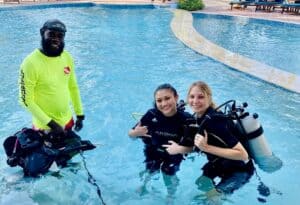
While we were closed in September for yearly renovations, Dive Master Shawn Lozano better known as “C-Dog” took time out of his vacation to go to Honduras and attend the PADI Instructor Development Course with Utila Divers. The course is run by Andy Phillips and it took two weeks to complete. It  entailed long days of class and water works culminating  in a two day exam which he sailed thru. C-Dog has now join the ranks of PADI Open Water Scuba Instructor and he is very enthusiastic for this coming season as a Hamanasi Instructor. He is looking forward to creating fantastic new divers and impart his knowledge of the marine environment with his new students.  Hamanasi is very proud of his efforts and wishes him the best of luck!

{ 1 comment }

“Facts on the lion-fish”

by hamanasi on November 22, 2010

lion-fish

Lionfishes belong to the scorpionfish family, which includes some of the most venomous fishes in the oceans. The lionfish has striped colours and spines of about 15 inches. They tend to take advantage of their camouflage to stalk their prey and when they are close enough, the lionfish quickly open their jaws to snap up their prey.  Its prey are usually small fishes, shrimps and crabs but it feeds on almost anything that can fit in their mouths and they always swallow their food whole. They feed all day long which allows them to consume much more than the average fish!

The lionfish has a lifespan of about 5-10 years and its native to the tropical Pacific and Indian oceans, but have recently been found in the Atlantic Ocean and Caribbean Sea near our barrier reef, far from their natural home. They live among the coral reefs and shallow bays. This unique fish has few predators. Some fishes may try to eat them, but lion fishes’ venomous spines protect them from most predators.

This family of fish, including the lionfish, are external spawners. The male expels sperm immediately after the female releases her eggs, and the eggs are fertilized as they float in the water. These eggs and the newly hatched larvae drift in ocean currents for 25 to 40 days. Once the hatchlings are large enough to swim, they leave the currents to hide among corals and rocks. It probably takes 1 or 2 years for these hatchlings to reach breeding age. A female can lay one million eggs in a year.

Lionfishes are in no way threatened, but they have recently been found in the Caribbean and along the East Coast, as far north as Long Island, NY. The presence of these Pacific fishes in the Atlantic threatens many species that have not yet evolved defences to these voracious predators.

Our warm waters are being invaded as we speak. The dangers of the lionfish are yet unknown but from the facts we know about them, we can assume that they will soon become detrimental to our second longest Barrier Reef. They live long and multiply by millions, along with that they are not prone to many predators which give them maximum chance of survival and the oomph to live.

Although there is no written law as yet to enforce this, many of our local fishermen, dive masters and environmental organizations are now taking it into their own hands to kill the lionfish. It is nature’s law that the lionfish should not be a part of our ecosystem in such prevalence. Many different dive shops have begun doing this to preserve the reef.

Here at Hamanasi we have made the first step that we believe can save our reef system.    This picture is one of the lionfish that we have came up with to spread the awareness. We have created posters that we have placed in our dive shop and on our dive boats to show guides and guests. So if you see any lion fish, be sure to let your dive master know! It will make a safe dive today and help our reef system to last longer for more exiting dives in the future.  The Hopkins Divers dive crew are monitoring and logging each fish killed, its location and the date since this fish is still under research in the US.

Here’s another idea! It has also been said that it makes a good meal for the people who have tried it; therefore the lionfish will soon be a part of many Belizeans’ menu. Think of a fish that is so plentiful with no season of when to catch!


{ 2 comments }

Hamanasi Guest Book – October 2010

October 31, 2010

Thanks to all of our the guest that visited in October especially to those who were here throughout the unexpected weather conditions.  Thanks again for being so understanding and cooperative about it.  It indeed was an Adventure in itself.  We look forward to seeing you again in the near future! “Such a low profile place [...]

Read the full article →

Hamanasi Greens Its Dive Boat Fleet

June 3, 2010

Hamanasi Greens Its Dive Boat Fleet Just in time for the 2010 whale shark diving season, Hamanasi Adventure Dive Resort in Hopkins has added a new eco–friendly custom–built dive boat to its fleet. The Hanóu, which means “Trigger Fish” in native Garifuna, can carry up to 25 divers and features four–stroke engines, which dramatically reduce [...]

Read the full article →

Nature’s Surprises

May 1, 2010

Sometimes Mother Nature surprises you with an unexpected encounter that is beautiful and thrilling!  These dolphins kept divers entertained throughout their dive yesterday as they searched for whale sharks.  No whale shark sightings for the day, but happy divers for the experience!

Read the full article →

Hamanasi’s New Custom 45′ Dive Boat Arrives

April 1, 2010

IT’S HERE!  “Hopkins Divers”, Hamanasi’s in-house PADI Dive Center, just received a new custom-built 45′ dive boat!  This boat is equipped with three 200 hp 4-stroke Suzuki engines and will be an exciting addition to the Hamanasi fleet!  The arrival is  a great kick-off for the 2010 Whale Shark season, as well as our daily Barrier [...]

Read the full article →

Whale Sharks in Belize 2009!

June 14, 2009

As the Whale Shark season for 2009 comes to a close this week, it has been a very exciting year for diving at Hamansi Resort in Belize! The Whale Shark is the biggest fish in the sea, and divers are fortunate every year to be able to have an excellent chance at encountering these gentle [...]

Read the full article →

2009 Whale Shark Season Approaches in Belize!

January 15, 2009

The Whale Shark Season for 2009 will soon be here!!! We are so fortunate here in Belize that each year during the months of April, May and June, during the full moon cycle, we have the privilege of diving with these majestic fish!

Read the full article →

Whale Shark Season 2008 Hamansi Resort, Belize

April 2, 2008

The 2008 Whale Shark Season has begun in Belize! Hamanasi is once again experiencing success in our efforts to give guests a once-in-a-lifetime experience at diving with the gentle giants. The first full moon cycle occurred in March, and Hamanasi’s highly experienced dive team took guests to Gladden Spit to see and enjoy one of [...]

Read the full article →